The Confidential

The ACC Sports Blog

Archive for the category “Conference Realignment”

Louisville to Face Rival Syracuse for Big East Title

Louisville unleashes its inner Cardinal(Credits: Madeline Hack)

Louisville unleashes its inner Cardinal
(Credits: Madeline Hack)

If someone had told me at the beginning of this season that our Louisville Cardinals would contend for back-to-back Big East Championship titles against a historic conference juggernaut in a matchup marking the storied history of the conference as it enters its waning days of existence, I would have thought that person had a great imagination.

Given the preseason hype surrounding this year’s squad, it’s not surprising we find ourselves right where we belong in the title chase.  Nor am I surprised our opponent comes in the form of our rival Syracuse.  However, no one could have predicted the changes the conference will undergo in the next year and that the final tournament would consist of a model foe versus a new foe.

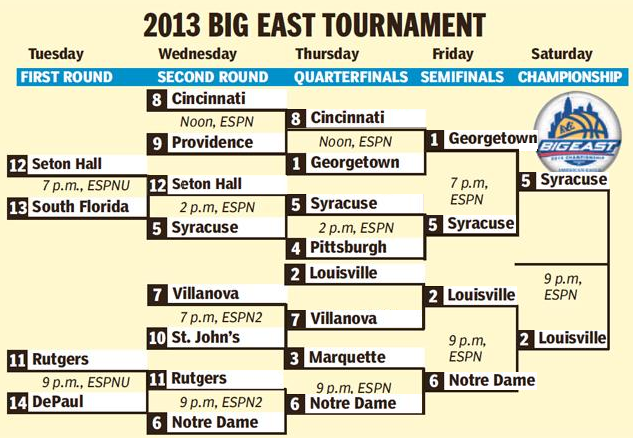
Here’s how we got to the tournament final:

2013 Big East Championship(Credits: www.bigeast.org)

2013 Big East Championship
(Credits: http://www.bigeast.org)

Since joining the league in 2005, Louisville has continued traditional conference rivalries and acquired new ones.  Aside from the annual Cincinnati showdown, no other rivalry has meant so much or garnered as much attention as the yearly conflicts with the Syracuse Orange.  There is no doubt this rivalry will continue once both programs enter the Atlantic Coast Conference.

It is only fitting that this epic tournament final would be fought between a classic powerhouse and our Cardinals, the winningest Big East team since we entered the conference.  Both programs have built lasting legacies as Big East programs and the combination of wins and losses and coaching staffs have allowed us to stand out among other teams.

As preseason favorites to contend for the conference title, Rick Pitino and the Cardinals have not disappointed.  This conference final will be epic – I couldn’t ask for a better way to end an era than with a face-off between two great programs on the national stage.

Having split the first two meetings earlier this season in conference play, the Cardinals and Orange will settle the score under the lights of Madison Square Garden at 9 p.m. on Saturday.

#L1C4 – Louisville First, Cards Forever

Expansion-Related Exaggerations- The Farce of Big 10 Academic Superiority

Even though the rumors of the ACC’s demise have quieted down somewhat (which just goes to prove the absurdity of their existence to begin with), I want to continue with my planned series on conference realignment. So today I’m going to tackle the most often mentioned reason to join the Big 10. No, it’s not television money…it’s research money.

It’s true that the Big 10 is a great academic conference. But the benefits of its research organization, the CIC, are greatly overblown. Universities can, in fact, collaborate on research with anyone they want to. They can work together. They can raise funds together. They can do all of the things that the CIC offers without ever even stepping foot in the Midwest. And they do- ACC universities already do this with great success. For example, the University of North Carolina has become the nationally recognized leader in concussion research. They’re working on it on their own terms, with the schools that they want to. Yet, they’re not in the CIC. And Virginia Tech is pushing the boundaries of renewable energy. Their solar house has become a nationally recognized award winner, but they’re not members of the CIC either.  It’s not the organization that innovates. And it’s not the amount of money that it has that changes the world. It’s the people, and ACC universities are home to some of the top research talent available.

But you might say that money DOES matter and that the CIC will provide this to prospective members like UVA and GT. Okay, so how do ACC schools stack up when comparing research dollars? A quick glance at The Center for Measuring University Performance’s “Top American Research Rankings” list, shows ACC schools like Duke, North Carolina, Virginia, NC State and Pittsburgh alongside Michigan and Wisconsin. That’s the Big Ten alongside the ACC- there’s virtually no difference. ACC schools benefit from their association with each other just like the Big Ten schools do. Research dollar rankings prove this.

And that’s without even touching academic rankings. The ACC far exceeds the Big Ten as a whole in the often mentioned US News and World Report findings. The ACC boasts 11 universities in the Top 60 (including Maryland), while the Big Ten only has 6. Even with Maryland gone, the ACC will have a remarkable 66.6% of its members in this top group, compared to the Big Ten’s 50%. Again, facts not bias.

Many Big Ten fans point to membership in the Association of American Universities. Since an impressive 11 of 12 Big Ten schools hold a spot in this organization, it’s no wonder that they cite this as evidence of their superiority. Who wouldn’t? Yet, while it’s true that the AAU boasts a truly elite group of universities, having an exclusive membership like a collegiate fraternity does not mean that its members are more academically advanced than their peers. Highly regarded universities such as Dartmouth (#10), Notre Dame (#17), Georgetown (#21), Wake Forest (#27) and Boston College (#31) do not hold membership in the AAU, but are all, rightfully so, considered to be among the top schools in the country (US News and World Report ranking in parentheses). Membership in the AAU is not a necessary part of, or even a precursor to academic success. It looks good to have a title beside a school’s name, but what the school accomplishes is much more important. ACC schools prove this everyday.

This article is by no means an outlet to demean the Big Ten, but to start a discussion. The Big Ten is an impressive collection of schools with great academic programs and a rich history- this can’t be denied. But it’s great for them, NOT us. We appreciate our history. We celebrate our success. And we’re proud of our top-notch academic programs. The facts speak for themselves.

While Fans Honeymoon, Louisville Releases 2013 Football Schedule

Louisville Football has only one more year of [insert conference name here] competition before entering the Atlantic Coast Conference.  While many fans would rather hit the fast forward button and quickly arrive to fall 2014 than sit through another lackluster conference season, the Confidential cautions those future seekers not to overlook the opportunity at hand.

Times of great change can be very exciting.  Remember back to the days of constantly surfing the internet for any update on UofL’s chances of getting into the Big 12?  Perhaps you were busy burning up the computer looking for a way into the ACC?  No doubt some of you were also keeping an eye out for SEC expansion news.  The last several years have been filled with a barrage of intensity, not to mention enthusiasm.

But don’t forget about the present just yet, my friends.  UofL athletics is still on its ACC honeymoon.  I don’t know about you, but at no point of my honeymoon did I ever wish for it be over.  The exhilaration of accomplishment can quickly transition back to mundane existence.  While memories of extravagant honeymoons can be easily summoned after the fact, we will never live in this existence again.

On Wednesday, the University of Louisville released its 2013 football schedule.  Most interestingly, the Cardinals have three bye weeks sprinkled throughout.  The most important bye appears in just the right place – the week before the season finale against rival Cincinnati.

8/31 Saturday Ohio PJCS
9/7 Saturday Eastern Kentucky PJCS
9/14 Saturday Kentucky Lexington
9/21 Saturday Florida International PJCS
9/28 Saturday Bye
10/5 Saturday Temple Philadelphia
10/10 Thursday Rutgers PJCS
10/18 Friday Central Florida PJCS
10/26 Saturday South Florida Tampa
11/2 Saturday Bye
11/8 Friday Connecticut East Hartford
11/16 Saturday Houston PJCS
11/23 Saturday Memphis PJCS
11/30 Saturday Bye
12/5 Thursday Cincinnati Cincinnati

If you’re looking at the schedule and letting out a huge sigh, you’re not alone.  The marquee games per se on the schedule are Kentucky, Rutgers and Cincinnati.  While Ohio, UCF, USF and Houston are no pushovers, there just isn’t too much substance for fans to celebrate in the 2013 season.

Alas, there will be no conference championship game as previously planned.  A ten-team league was formed when Boise State and San Diego State committed to the Big East, but their change of heart cost the league a season finale.

There has to be some good news about this schedule, right?  Well, if you consider the weak schedule as proper impetus to win every game and defend our BCS win, then yes.  If for no other reason, true fans should support the Cardinals as they attempt to end the pre-ACC days on a positive note.

I would love to wake up tomorrow to find Louisville and its athletic programs already members of the ACC and having kissed their shaky Big East days goodbye.  However, if that were the case, the honeymoon would be over and would soon become a distant memory.

It is only fitting that we fans wait for our future – it allows us time to reflect on our university’s rich history, athletic successes and academic trajectory.  Being wanted and feeling valued gives fans pride and a sense of being on cloud nine.  Frankly, I’m too comfortable for that sensation to pass.

May the honeymoon never end, UofL.

ESPN’s Big Monday

This blog entry was contributed by a guest, who chooses to remain anonymous (for now).  The Confidential greatly appreciates this guest’s opinion and welcomes others to submit guest entries–whether anonymous or not. 

Yes, we have been told that football drives the bus.  We get it! ACC football has a lot of questions to answer.   But for the purpose of this singular guest blog entry, let us concentrate on what the ACC does historically well … basketball.

For the last 30 years, the ACC and Big East have essentially traded punches in their all-out pursuit of being the dominant college hoops conference in the land.   Fittingly, I propose we begin our study with the memorable UNC-Georgetown final in 1982.   The conferences clash for the first time. In Dean, MJ, Worthy, Perkins vs. John Thompson, Patrick and Sleepy Floyd.   Great theater. And a three-decade long tug of war began with UNC claiming an initial victory.

 Including ’82, in 31 seasons, there have been 124 Final Four spots up for grabs.   And a team from the ACC or Big East claimed 49 of those berths. That’s a slick 40 percent and that does NOT include FF berths claimed by Louisville or Cincinnati in their pre-Big East days.

Now, the ACC’s immediate future won’t include Big East basketball heavies such as Georgetown, Marquette, UConn or Cincinnati, but it is safe to say when you combined the hoops heritages of (alphabetical order as not to offend anyone) Duke, Georgia Tech, Louisville, NCSU, North Carolina, Notre Dame, Pittsburgh, Syracuse and Virginia under one roof, the word “juggernaut” can justifiably be tossed around.

And, one cannot with good conscious sneeze at the histories and accomplishments of schools like Boston College, Wake Forest, Clemson or Florida State. Even Miami looks like a solid #2 seed this year, and Virginia Tech can beat anyone at Cassel Coliseum on a given night.

Oh. Maryland. Never mind. Another topic.

But there is no avoiding the fact that ACC hoops will be King. And it begs the question, what and where is the King’s throne?

My answer is that it should be on ESPN’s Big Monday at 7 p.m.

That’s right. Other than securing a football commitment from the Golden Domers, I think seizing the early slot on ESPN’s Big Monday should be near the top of the ACC’s Honey To Do List.

In the college hoops universe, Tuesday’s are Super, Wednesday’s are wonderful and Thursday’s are weekend-esque, but Monday’s are BIG. They are the proper and fitting platform for Kings.

Think about it.

  • The NFL rules the majority of January (and into February, Super Bowl). On at least two weekends, playoff games are scheduled for Saturday and Sunday. And yet, January is when the conference hoops slate gets started. These are important games. The ACC should seek to avoid these primo matchups being engulfed by Super Storm NFL Playoffs.
  • Since weekend hoops games are necessary, note that around 90% of weekend college hoops games fall on Saturdays. On weekends, anything beyond the NFL is sucked up by the NBA, the PGA Tour (I love the West Coast swing!!) and NASCAR (Daytona). So after gorging on sports all weekend and fending off the usual Sunday night/Monday morning depression, Big Monday is always there with open arms waiting to kick start a new sporting week.
  • There is a reason that traditionally ESPN puts its best CBB crew (Sean McDonough, Jay Bilas, Bill Raftery) on at 7 p.m. on Big Monday. Sorry, Mike Patrick, Dick Vitale, Doris Burke, Len Elmore and Adrian Branch, need not apply. For the record, Jimmy Dykes (aka John Calipari’s Press Secretary), Fran Frashcilla (Euro basketball does not matter to me) and Andy Katz (Mark Few’s shoulder to cry on) are NOT Big Monday worthy. Sean, Jay and Bill are as good as any three-man booth in any sport. They’ll do the ACC serious justice. They are BIG time.
  • Academically, the ACC’s Big Monday combatants could travel on Sundays and potentially have their athletes back in the classroom by Noon on Tuesday. This fact should matter in the equation.

I also realize there is a reluctance by ACC charter schools to accept anything that might be tainted Big East.

I get it. I graduated from a Big East school. I later worked in an ACC Athletic Department, so I am well aware of and greatly appreciate the ACC’s proud history.  I just hope that growth opportunities — such as a unique and almost exclusive platform on Big Monday – are not simply bypassed out of conference spite (a.k.a. anti-Big East bias).

In some limited instances such as Big Monday, what was once terrific for the Big East can render even greater returns for the ACC.

The Case for Navy to the ACC

Look, nobody knows what is going on with the rumors regarding teams leaving the ACC.  Depending on where you choose to read, the ACC may be extremely strong right now or extremely vulnerable.  The Confidential remains of the opinion that the absence of a grant of rights deal confirms that the Conference is at least somewhat vulnerable.  But, assuming it is not, there is still the issue of Notre Dame’s partial membership.  While the Confidential understands the lure of Connecticut and Cincinnati, and maybe even Temple, the Confidential would also like to make the case for Navy as the 16th school.

First, Navy could be considered in the same exact format as Notre Dame–a partial football schedule, with membership in the remaining sports.  Perhaps Notre Dame and Navy could split one share of the revenue somehow unless/until full football membership was resolved.

Picture this for divisions, with cross-over above/below:

Atlantic: Notre Dame, Miami, Virginia Tech, Louisville, Syracuse, Pitt, Boston College, Wake Forest

Coastal: Navy, Florida State, Virginia, Georgia Tech, North Carolina, Clemson, Duke, NC State

If ND and Navy could commit to the 7 division games, plus an 8th game between the two teams, this should make everyone happy and wealthier.  ND would still have 4 more games to spread among its OOC foes, such as USC and various Big 10 schools.  And the ACC Championship game could include Notre Dame.

Frankly, Navy has not been that bad in football anyway.  Credit Paul Johnson for putting them back on the map.  They are not a pushover.

Or, if ND/Navy are reluctant to go that high in terms of # of games, just keep them in parentheses… playing 5 games, plus the 6th game with each other.

Those divisions still work for hoops too.

Second, Navy is a fine academic institution.  There is no downgrade there.

Third, Navy has a lacrosse team, which would give the ACC its 6th lacrosse-playing school.

Fourth, Navy is located in the very place vacated by Maryland.  While Navy does not have the local following that Maryland does, it certainly has the national following.

Fifth, while its basketball team will always be undermanned, is that the worst thing for the conference?  There is already plenty of competition to get to the Big Dance.  And if Navy ever DID make it… they would have the whole country rooting for them.  Needless to say, Navy has not done well outside of the David Robinson era anyway.  So it’s no loss for the institution.

Finally, this keeps the UConn/Cincinnati debate alive should the ACC suffer additional losses.  It is likely that future expansion will be in pairs.  So adding those two teams together remains possible for backfill purposes.

What do you think?  Why yes or no?

Fast Forward: The ACC in 2016?

It’s 2016 and conference realignment has slowed down.  Again.  As most expected, the Atlantic Coast Conference has survived another round of unsubstantiated rumors and quasi-sourced reports from university big wigs and industry executives.  Overall, the past few years have proven quite productive in terms of membership and revenue.

A combination of ESPN affirming its financial commitment to the conference and the additions of Syracuse, Pittsburgh, Louisville, Cincinnati and Connecticut have made way for a 16-team league which boasts a great amount of competitive talent, geographic diversity and athletic tradition.

The ACC now has eight teams competing in men’s lacrosse with Cincinnati, Louisville and UConn adding the niche sport to their athletic departments.  Six of the league’s baseball teams are firmly in the Top 25 and seven teams are regulars in the women’s basketball Top 25.

College football has gradually improved over the past two years.  The Seminoles and Tigers have continued their top-tier presence in the rankings and Virginia Tech, Louisville, Cincinnati and Pittsburgh add some needed depth to the conference schedule.  NC State, Connecticut and Syracuse are steadily improving, the Tar Heels are sanction-free and competitive and Georgia Tech has awoken from its talent slumber.

College basketball is absolutely phenomenal.  Along with the annual Tobacco Road matchup, Syracuse-UNC has become epic in its short existence and Pitt has become quite the foe of Duke, NC State and Virginia.  Much anticipated matchups between Duke and Louisville and Connecticut and North Carolina have also given way to intense conference-wide games with Cincinnati and Pittsburgh.  The conference now boasts seven teams with national championship histories.

Although there is much competition among the field in both basketball and football, there is a great amount of talent at the top.  Many believe multiple ACC representatives will punch cards to the Final Four and there is guarded optimism a team will soon vie for the Coaches’ Trophy at Cowboys Stadium.

As with anything, it takes vision, determination and patience to see a great idea through to fruition.  The ACC is no different.  Fantasies often begin with unrealistic expectations while goals are accomplished through steady hard work and practical ambitions.

Congratulations, ACC!  You had the nerve and foresight to persevere and maintain your athletic tradition while maintaining and promoting solid academics.  The Confidential looks forward to many more years of ACC excellence.

**Is this article fantasy or realistic? Join the discussion below and let the Confidential know your opinion.

Louisville’s pre-ACC Options: Bring Back the Metro Conference

With all the focus on whether Notre Dame will follow the Catholic 7 into the new Big East for a year or be allowed to enter the ACC a year early, this observer turns his attention to what the University of Louisville will do (or be allowed to do) in light of the latest conference realignment development.

The worst-case scenario befell the Louisville, Cincinnati and Connecticut athletic programs. While each school was vying for the ACC’s glance in 2012, no one expected the possibility that there would be no home to return to if not selected.

While Louisville must come up with and be satisfied with a short-term solution, the Bearcats and Huskies are in a much worse position with no real future on any horizon.

Originally scheduled to officially enter the prestigious ACC in 2014, Louisville and its fans are quite content with that still being the case. However, the news that the Catholic 7 will compete in fall 2013 and take the Big East name with them arouses some understandable doubts about where the Cardinals will land in the interim.

This Confidential correspondent has pondered the many options available to all parties involved and believes one solution is tenable. A void will exist when/after the Catholic 7 take the Big East name and this means that the current member schools will need to either attach to another conference or come up with one of their own.

In my humble opinion, I believe the remaining schools should resurrect an idea whose time has come once again. Even though Louisville and Rutgers will be leaving for the ACC and Big Ten in 2014, I feel a viable option could be for them to help formulate a new version of the Metro Conference (Metro Collegiate Athletic Conference) for all sports.

At various points in time over the twenty year history of the Metro Conference from 1975 to 1995, Louisville, Cincinnati, Memphis, South Florida and Tulane were member schools. The league revolved around schools in metropolitan areas and eventually merged with the Great Midwest Conference to form Conference USA.

Although it disbanded, the conference had become a household name and boasted some other well-known member schools over the years, including Georgia Tech, Florida State, Virginia Tech, Saint Louis and South Carolina.

Let’s be clear: no one wants to go backwards in terms of tradition and program evolution. However, unless other conferences are open to cherry picking the residual Big East schools, there are really very few options and I suspect no one wants to go back to C-USA.

If the remaining schools were to band together and form a new conference, I believe one option on the table should be to revive the Metro league. It has name recognition, although a bit dated, and it fits the geographic locations of its would-be member schools and gives the beleaguered schools a new start with which to enter the future.

Assuming the schools agree to submit all of their athletic programs, Cincinnati, Central Florida, East Carolina, Houston, Louisville, Memphis, Rutgers, South Florida, Southern Methodist and Temple would make a 10-team conference for the 2013-14 season. In addition to compiling some household names, each member school would boast large metropolitan populations that could entice large media rights deals and revenues for the universities.

When Louisville and Rutgers leave, the new conference can then seek out new programs. The actions of Mike Aresco and the Big East brass in the past year have shown there is not a shortage of programs looking to realign themselves in this era of athletic musical chairs.

One thing is for sure: the time has come for some proactive decision-making by these schools. Although the Big East did its best to recruit new schools to join, the situation is what it is and the wrench the Catholic 7 have thrown into the conference’s future plans lends itself to some creative thinking.

If there are no other viable options, this option would enjoin dejected, outlying athletic programs into one conference with a goal of moving forward and finding common ground. Louisville and Rutgers can use their resources to help these programs before they leave for their new conferences. Although it will still appear like they are running out on them, they will nonetheless garner the attention and respect as two big-time programs that provided leadership to help everyone affected.

Feel free to comment and let me know what you think. At this point, only discussion and bold ideas can solve this problem. What are your ideas for the remaining schools?

**Mr. Cardinal is a new correspondent around the Atlantic Coast Confidential office. He graduated from the University of Louisville and is currently the Senior Editor of Empress World Publishing in Virginia Beach, Virginia.

Is ESPN’s Greed Causing it to Lose Profit?

Frank the Tank has a new article up on the Catholic 7’s new television deal showing that basketball has more value in expansion than previously thought.  The Confidential does not disagree.  However, with Fox offering big money for a basketball-only product–and taking that product away from ESPN–it is just the latest example of ESPN’s greed causing it to lose profit.  What this also shows is that ESPN made a killing off its undervalued contract with the Big East and is making another killing off of the ACC contract.

Think about it.  If the Catholic 7 collectively have a fair market value of $3M apiece–that is $21M right there.  TCU, Syracuse, Pitt, West Virginia, Rutgers, and Louisville have values of approximately $18M apiece–given that they were accepted into conferences that needed roughly that (more for TCU/Rutgers/WVU) to break even.  So that is $108M.  Figure ND is worth $6M for its non-football stuff… that is $135M ($21M + $108 + $6M).  And then you still have UConn, USF, and Cincinnati.  Even at $25M total for the three schools, that is $160M.

For that collection of schools, ESPN offered $11M per football school–or $99M/year.  With the hoops schools getting a few million apiece, that is another $20M tops.  So $120M.  $40M less than what the schools ultimately proved to be worth individually.  At the very least.

In the end, ESPN ends up with UConn, USF, Cincinnati, and fodder.  So much for that extra value.  By trying to profit as much as possible off the Big East, ESPN ended up losing most of it.

Sort of.  Some of it went to the ACC, which is also under ESPN’s control.

For now.

Regardless of the veracity of any rumors, there are vultures circling the ACC to see IF it is a carcass.

So the interesting issue is whether ESPN will lose its ACC golden goose also.  Viewed separately, all but a handful of ACC schools are desired by the Big XII, SEC, and Big 10.  Viewed conservatively, BC, Pitt, Syracuse, and Wake Forest are “stuck” in the ACC.  An argument could be made that BC, Pitt, and Syracuse might have value to the Big XII as part of a NE wing with WVU.  Interesting thought.  But let’s assume not.  If conferences making $20M/year (minimum) can find a revenue BOOST in adding the other 10 ACC schools, that must mean that those schools are worth at least $22M apiece or $220M.  Assuming the remaining 4 are worth $11M apiece (50%), that is $264M total.  Minimum.  It is probably much higher.

Well, ESPN is paying an average of $240M per year.  Less extra profit than with the Big East, but still a nice 10% premium above the bare minimum numbers discussed above.

The question this time is whether ESPN will allow the ACC–in its current form–to walk out the door.  For every ACC school that leaves for somewhere other than the SEC, ESPN becomes less relevant and Fox becomes more relevant on the college sports scene.  At some point, ESPN has to protect its place in the college sports game.  It wants to start an SEC Network, not become the SEC Network.  Right?  But, given what has happened at many major corporations, one can never underestimate the stupidity of an organization.  10 years from now ESPN’s college programming might be down to the SEC and 10 different shows where reporters yell at each other about college sports.  Or ESPN could end up overbidding on the Big XII or Big 10 because they put themselves into a desperate situation.  Who knows?

But it does seem like ESPN could save itself a lot of trouble by locking up the ACC.  That gives the network good football and great basketball.  Programming from September to March.  At the very least, something to keep it on pace with Fox.


Syracuse, Notre Dame, Pitt, and Louisville fans… get your Big East Conference Tournament tickets here:

Big East Basketball Tournament – All Sessions

ACC fans, get your tournament tickets here:

ACC Basketball Tournament – All Sessions

Notre Dame, The Big East, and the ACC

Well, it looks like the “Catholic 7” that are leaving the Big East are going to be taking the name–The Big East–with them.  As Frank the Tank points out, the Big East name still has value to those schools.  Indeed, Georgetown, Villanova, St. Johns, Providence, and Seton Hall have been part of the Big East for a long time.  In contrast, only Connecticut has a comparatively long history.  In the end, it certainly seems like this is a fair result.

Frank notes that Fox is paying for this move.  So it is yet another defeat for ESPN in the “war” between the two sports programming giants.

The interesting part is what happens with Notre Dame.  If the “Catholic 7” leaves before the 2013-2014 basketball season, what happens to the Fighting Irish?  Do they stay as a part of the diminished Former Big East, with games against UConn, Temple, and the C-USA teams?  Do they go with the Catholic 7 for one year while waiting for the ACC to create a spot?  Will the ACC create a spot for the Fighting Irish?  There are a lot of moving parts here.  In any event, the unlikely event of Notre Dame being in the ACC for the 2013-2014 basketball season is no longer quite as unlikely.

Oh, and let’s not feel TOO sorry for Connecticut, Cincinnati, and South Florida yet.  With all the defections, as well as the desperation for the Catholic 7 to leave and take the naming rights to the Big East, they might be left holding all the NCAA tournament credits and the exit fee fund left behind.  There is talk that this funding will be in the neighborhood of $68 million.  That is better than a sharp stick in the eye, anyway.

In any event, the main thing to keep an eye on is what happens to Notre Dame.  That will have to get resolved pretty quickly.

Conference Realignment–What if the ACC, Big 10, SEC, and Big XII Worked Together?

So far, conference realignment has been about taking… usually in the form of a happy conference (stealing a school), a happy school (happy to be stolen) and–cue the sad trombone–a sad conference (losing a school).  So far, the unhappy conference has usually been the Big East, but the Big XII has lost Missouri, Texas A&M, Colorado, and Nebraska, while the ACC has lost Maryland.  Only the Pac-12, SEC, and Big 10 have been exclusively happy.  In the meantime, there are rumors upon rumors of the ACC being carved up, with fewer (but existing) rumors regarding the Big 10 eying more Big XII schools.  But what if the ACC, Big 10, SEC, and Big XII sat down and worked on a plan that would keep each of these conferences roughly happy, while allowing each conference to arguably expand its market base?

Consider that the Big 10 has eyes on the Southeast market, but is leery of alienating its midwestern base/roots.  While some people talk about expanding to 18 or 20, these additions always involve Michigan and/or Ohio State moving to the eastern side.  On the other hand, the Big XII has a grant of rights that makes it more difficult to pry away a school.  But what if everyone sat down and came up with a plan that would kind of/sort of make everyone happier.

First, the Big XII would give up its GOR rights for Kansas, allowing them to slide to the Big 10.  In exchange, the ACC would give up Pitt, who would slide to the Big XII.  The SEC would give up Missouri.  In exchange for Missouri, the ACC would give up North Carolina State.  Missouri would go to the Big 10.  The Big 10 would be at 16, the SEC at 14.  At 10 members, the Big XII would have the option of taking Cincinnati and USF to move into further new markets (Ohio and Florida), while also adding a conference game.  The ACC could take UConn–adding a new market to replace the NC State “market” lost.  The ACC could also take Temple, adding a private school in the Pennsylvania market.

This would result in:

SEC East: Florida, Georgia, South Carolina, NC State, Vanderbilt, Tennessee, Kentucky

SEC West: Alabama, Auburn, LSU, Arkansas, Mississippi, Miss State, and Texas A&M.

Big 10 West: Nebraska, Missouri, Kansas, Wisconsin, Minnesota, Illinois, Northwestern, Iowa

Big 10 East: Ohio State, Penn State, Maryland, Michigan, Rutgers, Purdue, Indiana, Michigan State

Big XII South: Texas, Texas Tech, Baylor, TCU, Oklahoma, Oklahoma State

Big XII North: West Virginia, Pitt, Cincy, USF, Iowa State, Kansas State

ACC Atlantic: UConn, BC, Temple, Louisville, Clemson, Georgia Tech, Florida State, (ND)

ACC Coastal: Syracuse, Duke, Wake Forest, Virginia, North Carolina, Virginia Tech, Miami, (Navy–same deal as ND, only less money?)

Issues:

Big XII loses Kansas–a major basketball power.  However, Kansas is also terrible at football.  The Big XII stays strong in football at the top by adding Cincy and USF–two beatable teams in great markets for recruiting.  Cincy and USF are on the upswing in hoops too.  Pitt is very established in hoops.  A nice home-and-home pod with Pitt and Cincy for West Virginia.

SEC loses Missouri, but picks up NC State.  A market for market swap that probably hurts the SEC somewhat.  But the SEC adds a school that gives inroads into North Carolina, while further fitting in better on the Eastern side.  If, in 10 years, the SEC and Big 10 decide to carve up the ACC–the SEC has a lure for North Carolina–State is already there.  Meanwhile, NC State is more of an SEC school in terms of football zeal by the fans.  The basketball program could thrive freed from the shadow of Duke and UNC too.

The Big 10 gets a stronger Western flank with Missouri and Kansas.  With both schools freed of games against the powers of the SEC and Big XII, they could thrive.  The divisions finally start to make geographic sense, allowing for a 9 game schedule–7 games inter-division, plus two games against other division.

The ACC loses NC State and Pitt–two decent football programs.  UConn and Temple are a downgrade… but this staves off a loss of the major football powers and the major markets/leaders.


Of course, in a perfect world, the existing conferences could sit down and make complete geographic sense.  But that cannot happen.  In the interim, however, the conferences could work to share markets to allow all TV deals to slide upwards.  Although it is will get the most criticism, the Big XII would really be the big winner here.  The adds of Pitt, Cincy, and USF would open up three major recruiting markets, without exactly taking on terrible metro markets (Pitt, Cincy, Tampa).

What do you think?  Even if impossible, does it make sense?


Post Navigation