The Confidential

The ACC Sports Blog

Archive for the category “Conference Realignment”

Weekend Topic: ACC Football Divisions

The folks over at Tomahawk Nation have a nice debate, albeit FSU-centric, as to how the ACC divisions should be reconfigured.  So let’s delve in and discuss.

Given that the current divisions are just a random collection of whatever that nobody could possibly remember, here are they are as of right now:

Atlantic: Florida State, Clemson, NC State, Wake Forest, Maryland (Louisville in 2014), Boston College, Syracuse

Coastal: Miami, Georgia Tech, North Carolina, Duke, Virginia, Virginia Tech, Pittsburgh

The Confidential has previously advocated for a quasi-geographic breakdown of the teams.  John Cassillo over at atlanticcoastconvos proposed the same thing on the Tomahawk Nation blog (midway down):

Atlantic: Miami, Virginia Tech, Virginia, Syracuse, Boston College, Pitt, Maryland (Louisville)

Coastal: Florida State, Clemson, North Carolina, Duke, Wake Forest, North Carolina State, Georgia Tech

The teams are listed above/below a permanent crossover.

This is essentially the “Old ACC less Virginia.”  Or N/S, plus Miami and Louisville.  Miami works with the North.  Virginia?  Maybe, maybe not.  But they would play UNC every year.

But the FSU folks have an interesting suggestion or two, including a straight–let’s get a strong strength of schedule method proposed by SirChancelot:

Atlantic: Florida State, Virginia Tech, Clemson, Miami, Louisville, Pitt, Virginia

Coastal: Duke, UNC, NC State, Wake Forest, BC, Syracuse, and Georgia Tech

The logic being that the football schools can beat up on each other and establish a strength of schedule that matches up with the SEC.  And if the ACC-Championship Game is garbage, so what?  It always is anyway.  Better to have the 11-1 team get to 12-1 without hassle.  Frankly, the Confidential sees some logic in it, but questions the choice of schools.  How about this instead:

Atlantic: FSU, Miami, Va Tech, Clemson, Georgia Tech, NC State, Louisville

Coastal, UNC, Duke, Wake Forest, BC, Syracuse, Pitt, Virginia

If anyone runs the table in the Atlantic, they should be sitting pretty from a strength-of-schedule standpoint.

Of course, if anyone runs the table in the ACC in any format, will they be excluded from a strength-of-schedule standpoint anyway?  That seems to be a fabricated issue.  It is not strength of schedule that harms the ACC schools, it is losing to teams that one should not lose to.

Moreover, playing all those games may help the strength of schedule, but wouldn’t it increase the chances of a bunch of 4-3 teams.

The Confidential’s perspective is that the ACC has a poor image because it is not top-heavy enough.  The B1G is Michigan and Ohio State usually.  The Big XII is Texas and Oklahoma usually.  The Pac-12 is USC or Oregon usually.  Exceptions happen obviously, but that is what we can expect.  The SEC is great because there are 5 teams that have the ability to run the table–and one or two of them usually do.  The ACC may have a couple of schools that “can,” but they always falter along the way to middling schools.  Bunching up the great teams is not going to help.  However, the idea of ignoring competitive balance has merit.  One can never get it straight anyway.

Otherwise, the suggestions over there involve a re-assortment of the current system.  Swap Miami for Florida State, or Clemson for Georgia Tech.

Nobody suggested this one… organize by number of words it takes to state the school:

Atlantic (1 word): Clemson, Miami, Pitt, Louisville, Virginia, Duke, Syracuse

Coastal (2 words): Georgia Tech, Florida State, NC State, North Carolina, Virginia Tech, Boston College, Wake Forest

Actually, that is not bad competitive balance for football.  Hmmmm.

From the Confidential’s perspective, the priority of the conference should be as follows:

  1. Maximizing TV revenue–gotta keep up with the Joneses
  2. Maintaining traditional rivalries
  3. Easy of remembering divisions –nobody should have to look up who is in each division, whether an ACC fan or not
  4. Maximizing gate revenue–more $$$
  5. Competitive balance
  6. Ensuring high strength of schedule
  7. Other?

What do you think–what is THE most important thing that the ACC must consider if/when rearranging the divisions for football?   What is your proposal?

4-22-13: An ACC Holiday

The ACC’s obituary was written many months ago.  The Big 10–fresh off a harvest of Maryland and Rutgers–would be descending on the ACC and taking enough teams to get to 16, 18, 20, 0r 22.  The issues were merely who and how many.  Meanwhile, the only other issue was whether the ACC’s carcass would be feasted on by the Big XII and SEC at the same time, or whether these conferences would be waiting for the Big 10 to “choose” first.  Well… and it is great to say… you couldn’t have been more wrong.  Instead, as reported here and elsewhere yesterday, the ACC schools have decided to sign a grant of rights.  Much like a grant of rights solidified the Big XII, this grant of rights also solidifies the ACC.

So what are the winners and losers with this announcement:

THE WINNERS:

The ACC schools.  The ACC is a conference of elite academic institutions.  The Big 10 and Pac 12 are also conferences with elite academic institutions.  Had the ACC broken up, it would be meant the dissolving of a fine partnership over athletics.  There is something neat about having Boston College, Miami, Syracuse, and Duke all joined together in a conference.  Add in Notre Dame and Wake Forest, and that is a nice collection of private institutions not seen in any other major conference.  Meanwhile, Virginia, North Carolina, Georgia Tech, Virginia Tech, and Pitt are excellent academic institutions on the public side.  And Florida State, Clemson, Louisville, and North Carolina State continue to improve.  The latter are, well, pretty good at football too.  But the real win is that these schools adhered to the idea that the potential value of this conference should not be squandered in the hope of more money immediately.  For once, someone left money on the table.

Syracuse, Wake Forest, Pitt, Boston College, Virginia Tech, Duke, Miami, and Louisville.  In some scenarios, these schools would get left out of realignment.  They avoided this fate, at least for now.

ESPN.  ESPN was somewhere near the brink of potentially losing  control of the eastern seaboard.  Maryland and Rutgers were shuffling off to the midwest to be featured in the Big 10’s network jointly owned by Fox.  If the Big 10 captured a few more, or several more, ACC schools… only the SEC could take on ACC schools–maybe 2?–to keep them under ESPN control.  Maybe the SEC could have landed North Carolina and Duke.  Or maybe they would have been “stuck” with North Carolina State and Virginia Tech.  Good football schools, but schools overshadowed academically by their state flagship schools.  And any ACC schools heading to the Big XII would move away from full ESPN control to partial ESPN control.  Finally, if the Big 10 had gotten too big, ESPN would have had to pay dearly in 2015 to keep their rights.  Frankly, keeping the ACC might have been a cheaper option.

Frank the Tank.  The author of the best expansion blog on the Internet had been saying forever that the ACC was strong.  The Maryland departure, and the echoes from some less-responsible bloggers regarding future Big 10 targets, made even Frank the Tank question just how strong.  But at the end of the day, his belief in the ACC prevailed.

ACC Leadership.  Questioned by many, the ACC home office seems a lot more competent today than they did 8 months ago.

THE LOSERS:

The West Virginia Bloggers.  Look, West Virginia got kind of a raw deal by being passed over for, ultimately, Louisville.  Of course, when is the last time West Virginia won a national championship in hoops?  In any event, few schools in the ACC had serious animosity toward West Virginia.  Pitt, Syracuse, and Virginia Tech (and Maryland presumably) would have liked to see them in the ACC.  Not the other way around.  Fortunately, when that did not pan out, the Mountaineers ended up with a very soft landing in the Big XII.  The response?  Echoing the lack of class from the school’s athletic director (saying Navy was an upgrade over Syracuse in football), a few select bloggers made a name for themselves guaranteeing the destruction of the ACC.  Not just that it was a possibility.  No, these fools claimed that it was fact.  Imminent fact.  Well, folks, you are running out of time for that fact to come to fruition.  So, while your imaginary sources may still whisper in your ear from time-to-time, the fifteen minutes of fame is over.

Some of the Frank the Tank Commentariat.  Like something out of Willy Wonka, some of the commentariat over there acted like spoiled children.  Person A: “NO, I want Duke, North Carolina, Virginia, and Florida State.”  Person B: “NO, the Big 10 should take Georgia Tech, Boston College, Duke, North Carolina, Florida State, and Notre Dame.”   Person C: “You folks think small… the Big 10 should take everyone except Syracuse, BC, Wake Forest, and Louisville.  They should then take Texas, Florida, USC, and China.  Look at that market share!!!  We’ll be rich!”  And so on.  The Confidential understands that expansion is fun to talk about.  But the degree to which “money” became the only statistic that matters was beyond absurd.  Even if the Big 10 COULD make lots more money by adding in schools in great markets, there is more to this game than mere money.  When the blog first started taking off, people ignored money.  Now, money means too much.  Money is nice… but there is something to be said for athletic prowess.  At the end of the day, the SEC’s adds of Texas A&M and Missouri likely trump Rutgers and Maryland, on and off the field.  That book has many more chapters to write.  But let a few of them get written before declaring it a best seller.

UConn and Cincinnati.  A poached ACC was an inviting home.  A solid ACC?  Not a great sign.  Things can change though.

Expansion Fans.  While the aforementioned speculation got carried away by some, the speculation sure was fun.  This all started with the Big 10 looking for team #12.  It ended with a 10-team Big 12 and a 14-team Big 10.  Along the way, the Big East had teams in Idaho and California briefly.  And now there is something that we cannot call the AAC.  While the aftershocks of realignment will continue to ripple through the mid-major and minor conferences, the ACC’s Grant of Rights may just slow down expansion within the 5 power conferences.  If so, things may not be as tense for ACC fans, but they will also be slightly less interesting.

What do you think?  Any incorrect winners & losers?  Anyone omitted?  You tell us…


Conference Expansion is Over? Post Grant-of-Rights Moves for the ACC

In case you haven’t heard the big news (see tjcuseacc’s post below), the presidents of the ACC unanimously agreed to sign their media rights away to the conference through the 2026-2027 season today. Yes, even Notre Dame (without football, of course). That’s huge. Now if anyone wants to leave, we can basically still own them even though they’ll be playing other teams. So go ahead, Virginia. If you want to travel and play Indiana instead of Duke you can. But it’ll cost you.

This is the “Grant of Rights” thing that had the entire Internet proclaiming the safety of the Texas (Big) 12, even though they’re about as stable as a broken chair. Despite our huge media markets, overall athletic quality and strong history, it’s the only thing that basically separated us from this level of security. But the gap has been closed.

So take a deep breath. Not only does this pretty much kill all of the WVU-blogger talk that our league is about to explode, but it gives us all hope for the future. How about that, Maryland? So what’s next? The league’s leaders have certainly come a long way in the last few months- inviting Louisville (which looks like the smartest move EVER now), pledging solidarity, announcing the creation of a network study….but there’s a lot more to do.

1) Create the ACC Network- We all knew that it was only a matter of time, and the grant-of-rights is exactly what ESPN has been waiting for. If the network didn’t think that the teams were committed to each other, why would they have wanted to throw a lot of money in our direction? They wouldn’t have…but now they can. What television network wouldn’t want a strong presence in Boston, New York, Pittsburgh, DC, Richmond, Raleigh/Durham, Charlotte, Atlanta, Miami, Louisville? Right. This is pretty much a no-brainer. Yes, the Worldwide Leader has pledged a lot of money to the SEC through its own network. But a lot of the markets overlap, and if bundled together, ESPN would have a hold of the preeminent football and basketball brands in all of college sports. We already knew that the league was studying this. We weren’t sure if ESPN is interested. But after today, they pretty much have to be.

2)  Divisional Realignment/Addition of More League Games in Football- It’s not a secret that most fans don’t like the Atlantic and Coastal divisions. It’s not really the names. They actually make sense, unlike the soon-to-be-defunct “Legends” and “Leaders” in the Confidential’s least-favorite conference. But what should the league do? North and South divisions aren’t really feasible, even if they seem obvious. Every team that would be in the “North” division wants to play a Florida team each year. Recruiting IS important, after all. And slotting Miami into the North, while sensible, due to their Big East roots, seems awkward. You can’t move Virginia Tech either. The Hokies LEFT left the Big East so they could play more Southern teams; they don’t want to be in the North. That and John Swofford doesn’t want to make his most consistent team unhappy. Especially when they have a spot waiting for them in the SEC, grant-of-rights notwithstanding. Let’s not even get started with Virginia.

So what CAN the league do? They HAVE to go to 9 conference games…at least. The Big 12 does it. The Big 10 is doing it. More league games just makes sense. It makes scheduling easier, and more predictable, which is actually what fans want- even if they’ll say they want variety. League games matter. Games against FCS teams don’t. That’s why fans don’t show up, FSU. That’s why the Big 10 has outlawed FCS games for their teams in the near future. UNC is in the same league as FSU to play them all the time…not once every 5-8 years. So let’s say 10 conference games; no FCS games; a permanent out-of-conference rival; plus Notre Dame every three years. With that, a new scheduling model would develop.

What if each team had TWO permanent partners on the other side. UNC’s would be NC State and Wake Forest. That’s sensible. Now what if the remaining 5 teams were grouped into two categories (this is for UNC)- longtime rivals (Clemson, FSU) and new faces (BC, Syracuse, Louisville). What if we had non-permanent partner games with our longtime rivals more frequently than with the new faces? Wouldn’t that make everyone happy and create exciting match-ups for fans and television? Check out some of UNC’s potential future schedules under this model-

2014

Georgia Tech                     Miami

Duke                                     Pittsburgh

Virginia Tech                      Virginia

NC State                              Wake Forest

Clemson                              Louisville

Tennessee                          Notre Dame

2015

Georgia Tech                     Miami

Duke                                     Pittsburgh

Virginia Tech                      Virginia

NC State                              Wake Forest

Florida State                       Boston College

Tennessee                          East Carolina

2016

Georgia Tech                     Miami

Duke                                     Pittsburgh

Virginia Tech                      Virginia

NC State                              Wake Forest

Clemson                              Syracuse

Tennessee                          Maryland

Those are great schedules. You’ll notice that that UNC will play Clemson and Florida State every other year. That’s a win-win situation for fans AND networks. It makes scheduling easy. And it actually feels like a conference again. The new yearly game against Tennessee? Why not? There have been rumors about an ACC-Big 12 scheduling alliance and that really makes sense. But almost half of the ACC teams already have a regular rival in the SEC and our leagues overlap geographically. So maybe we just have to suck it up and play #1.

As a fan, it’s hard to find anything wrong with those schedules. Yes, they would need to be worked out for every team. And it probably wouldn’t be this simple. But the reasons to change the current model are. The league has experience a lot of growth in the past few years. Let’s continue to adapt and change for the better.

What do you think? What do you feel that the ACC’s next move should be?

Update on ACC Revenue

CBS is reporting that the future addition of Notre Dame will have an immediate impact on revenue.  Even with just a 5-game football schedule and basketball games, Notre Dame will contribute in excess of $1M additional to the television revenue for each school.  While this is not “catching up to the Big 10” money, the gap between the conferences is not as wide as reported.  This may be why there are lots of rumors regarding schools leaving, but few actually doing so.

That same article also reports as follows regarding an ACC Network:

The ACC is currently considering a 24-hour sports channel with ESPN, which is gathering information and will return to the league with an assessment. If ESPN makes an offer the ACC likes, plans for a channel might commence. The league is evaluating whether a channel makes the most business sense.

Look, who knows if an ACC Network would be successful?  What is clear, however, is that the Big 10 Network is successful. This is where things are headed.  If there is not going to be an ACC Network, then ACC teams might very well end up on the Big 10 Network, to ESPN’s loss.

Perhaps ESPN would benefit from some sort of joint network between the SEC and the ACC, where both channels are a package that is available from the Northeast down to Florida and West to Texas.  That’s a lot of territory to bundle the packages together.  The price could be determined by media market.  The SEC channel could be 90 cents a month in Texas, while the ACC channel could be 10 cents a month there.  But in North Carolina, it could be the inverse.  The extra revenue provided by the bundling would help get both channels more market saturation.

Then again, the Confidential is hardly a financial or television tycoon.  Perhaps ESPN is moving towards jai alai, as that will be the sport of the 22nd century.

What do you think?  ACC Network have ANY potential?

What’s New in Conference Expansion

The Confidential is going to take a quick look around the conferences to see what is going on in conference expansion news:

The Big 10–the commentators over at Frank the Tank are busy arguing over whether the Big 10 will be taking some of the ACC or all of the ACC.  The blog author, himself, is focused on the division realignments with Rutgers and Maryland coming aboard soon enough:

It appears that the Big Ten office is heeding the calls for the “Keep It Simple Stupid” approach of dividing the soon-to-be 14-team conference into East and West divisions, with Michigan State heading East with Michigan, Ohio State, Penn State, Rutgers and Maryland, the West having Illinois, Northwestern, Wisconsin, Nebraska, Iowa and Minnesota and the only debate being where Indiana and Purdue will be placed.  IU-PU will then be the only protected cross-division rivalry.

It’s a pretty Big 10 centric place.  They are trying to decide whether 14, 16, 20, 80, or 200 teams is best.

The SEC–Mr. SEC has quoted the Missouri athletic director Mike Alden as essentially saying that the SEC will stay at 14 teams unless it decides not to.  Sounds like they are not doing anything.  Unless they do.

The Pac-12–This conference is in Monopoly jail.  Nowhere to go expansion-wise.  Unless Texas decides to come west, who would they add?  Boise State is not academically suited, nor is UNLV.  San Diego State and New Mexico are not worth expanding.  BYU is too religious.  So much for that.

The Big XII–nothing new to report on this front.

The ACC–nothing new to report on this front, other than the expectations of future pillaging.

The Big East–is now a basketball conference, having added Butler, Creighton, and Xavier.  They also have the name The Big East, having taken that from the Big East leftovers.  With Marquette and DePaul joining those three in the West, and Georgetown, Seton Hall, Villanova, St. Johns, and Providence in the East, that is not too shabby of a hoops conference.

The Big East leftovers now have a new name– the American Athletic Conference.  Tulsa is the latest addition to this group.

Conference USA– is thinking about going to 16 teams.  Heck, the Confidential did not even know that they had 14, especially after the American Athletic Conference has taken so many.  Western Kentucky will be taking Tulsa’s spot.

Beyond that it just gets way too confusing.  Too many moving parts.


The American Athletic Confidential Looms?

As we know, the Big East is no longer.  Well, that’s not true exactly, as the Catholic 7 are taking the Big East name, adding a few schools, and carrying on the business of basketball relevance.  The Big East leftovers, as they have been called, are apparently set to choose a new name–the American Athletic Conference.

Apparently, teams like Connecticut and Temple were tired of the jokes about the Big East having, albeit temporarily, San Diego State and Boise State in a conference in the “east.”  No longer will this be a problem, as the American Athletic is large enough to encompass anyone–from Maine to Hawaii.  If you are an American school, you can be invited someday.  And perhaps will.

The Confidential thinks the AAC members sold themselves short.  American Athletic Conference is a name that is waiting to be dissolved, like Conference USA.  There is nothing about it that fuses the teams together.  American?  Check.  Athletic?  Check.  Wanna be part of our conference?  Check.  Welcome to the Club.  Vanilla.

The question that begs is whether people will get the AAC and the ACC confused?  Maybe that is what the AAC is hoping for.

Of course, the Confidential wonders whether it is time to franchise.  Anyone want to star the AmericanAthleticConfidential?  C’mon, all you Houston, SMU, and Tulsa fans…


Huge News: West Virginia to ACC in 2014-2015!

The ACC and West Virginia have scheduled a press conference for 3:00 p.m. today to announce that the Mountaineers will become a full-time member in the ACC for the 2014-2015 season.  West Virginia was able to extricate itself from the Grant of Rights on the basis that both sides just felt that it was a mistake, couple with the fact that Brigham Young is finally ready to join the Big XII.  With 13 teams being unwieldy, and no suitable schools for a 14th, this just made the most sense.  The oft-discussed cooperative efforts of the Big XII and the ACC came into play obviously too.

Winners:  West Virginia, obviously.  Gets to reinvigorate rivalries with Pitt, Syracuse, and Virginia Tech.  The ACC–gets a football school to help placate the masses, while awaiting a Notre Dame decision.  The Big XII–West Virginia was always a geographical outlier.  BYU–they almost lost out on being at the grown-up’s table.  This salvages that.  The Big East leftovers–this stabilizes expansion for a while.  Hopefully.

Losers: Connecticut and Cincinnati.  They are plainly on the outside right now.   They will have to wait for defections from the ACC, which seem a bit less likely now.  Marylandwho considers West Virginia a rival, for some reason.

Big Losers: Us, for posting this April Fool’s Joke in such a very cruel manner.   Those people who will not realize that this is an April Fool’s Joke and/or post on Twitter that it is.  Nobody likes a spoiler.

ESPN’s Big Monday (UPDATE)

UPDATE:  Our guest writer just pointed out that the Miami Herald reported the following:

The ACC says it likely will take the Big East’s 7 p.m. slot on ESPN’s Big Monday next season. The new Big East – including seven Big East defectors, Xavier, Creighton and Butler – is shifting to the new Fox Sports 1, a 24-hour-network that debuts in August, replacing Speed.

So it looks good for the ACC to get the Big Monday slot.  Good news there. 

2012-13: Year of the Louisville Cardinals

#L1C4(Credits: www.gocards.com)

#L1C4
(Credits: http://www.gocards.com)

As I sit and look at the bracket and ponder about how the Louisville Cardinals gracefully landed in the top spot, many thoughts about my alma mater come to mind.  The superstitious person in me doesn’t want to speak about the excitement I feel as we begin the future and the tournament as the favorite.  Saying these things aloud could have detrimental effects.  Maybe.

Please be advised that the following article is not me speaking.  Rather, I share my thoughts out of respect for the team and conscious of my part in not producing a disaster.

[So, Louisville won a share of the Big East regular season title and then went on to win the conference tournament.  Wow. In its last year as currently aligned, the Big East from 2005 to 2013 will go down in history as arguably the toughest conference in the country’s collegiate basketball scene.  The pride I feel as a graduate of the university is palpable to anyone who encounters me – notwithstanding church events and tennis matches as a coach at a local high school, I have been wearing nothing but Cardinal gear for the past year.

2012 was a soaring year for Cardinal athletics.  From the numerous Big East championships won across the program to keeping Charlie Strong as head coach of football to being invited to the ACC to winning the Sugar Bowl in striking fashion to having a fabulous season in basketball, I’m not sure what else I could have asked for as a fan.  Sure, playing for a national championship in football would have been nice, but I’m confident that rosy scenario will someday arise and I don’t believe any fan could possibly be disappointed with Charlie Strong & Co.’s success thus far.

And let’s not forget about academics.  When West Virginia was chosen to join the Big 12, I think it’s fair to say the decision was based solely on the Mountaineers’ earned status as a football powerhouse.  In contrast, UofL’s unanimous selection as a future member of the Atlantic Coast Conference was purely a decision made with all facets of the university’s attributes in mind.  Everyone knows our athletic programs and facilities are top notch, but keep in mind that the ACC, much like the Big Ten, would not allow any school to enter its ranks unless it saw something tangible and obvious in the academic reputation of the institution.

When Florida State was added to their ranks, detractors complained that FSU’s academics were not strong enough to warrant admission.  This sentiment has been repeated about UofL and, of course, I take offense to it.  We have a Top 100 law school, a respected medical school always pushing the envelope, a business school which receives accolades on a yearly basis and an undergraduate program dedicated to a vast plethora of academic programs.  The university’s footprint is seen throughout the commonwealth and we are well represented across the nation in business, research and academia.

What the ACC saw in Florida State is akin to what it now sees in UofL – the trajectory of the university’s academics are on the rise and rising fast.  While not at the AAU level (besides, the AAU’s wheels of adding member universities is arguably much slower than those of the judicial system), Louisville will soon become associated with consortiums and programs alongside institutions like Duke University and UNC Chapel Hill and Wake Forest University and the University of Virginia.  That association and willingness to share academic success and research opportunities with all ACC members partially strengthened FSU’s reputation and no doubt Dr. James Ramsey kept his university eye on the ACC for this reason.

There is a reason there were all kinds of rumors and reports that we had an invite “in hand” to the Big 12 but were not acting on it.  It’s one thing to say that a source believes something might happen, but to say that an invite was already extended and the ball was in our court is a whole ‘nother beast.  Personally, I believe Dr. Ramsey and athletic director Tom Jurich had agreed early on that the ACC would be the better body to associate with,  and with time and continued diligence on our part, that invite would come.

But back to the major event ahead of us.  The NCAA tournament is perhaps the most widely known event in America, save the Super Bowl and the Kentucky Derby.  We have already proved that our football program was indeed worthy of the ACC’s glance and we have shown that our basketball legacy is strong enough to be included with the likes of Duke and North Carolina.  However, on the biggest stage in America in the same timeframe as our invite to our soon-to-be new conference, winning the tourney will blow the roof off every building in Louisville.  It’s that big of a situation here in Kentucky.

Nothing else matters right now.  The banter with Kentucky fans, the arguments from detractors, the long-positioned monkey of Big East football on our backs, the unspoken title of Little Brother, the association with “poor and backward” Appalachia – none of it matters.  Of course, those things have never really mattered to many of us living in the Bluegrass State, but I think it’s safe to say nothing else has mattered less that those do right now.

The Road to the Final Four should be tread with a determination unlike any other, and I know Rick Pitino, Peyton Siva, Gorgui Dieng, Chane Behanan, Russ Smith, Wayne Blackshear, Stephan Van Treese, Kevin Ware, Luke Hancock, Montezl Harrell and everyone associated with basketball team has it in them.  Every indicator points to the events of the 2012-13 season as the Year of the Cardinals.

This has been a long time in the making, my friends.  Perhaps I am more biased than the next guy, but living in the City of Louisville and seeing and experience all it has to offer makes me fully believe we are an idea whose time has finally come and will continue to come to many around the country.

Go get ‘em Cards.  Represent your fine university, represent your big city and represent your upstanding identities.  Win or lose, this is a special time in Louisville.  Good things come to those who wait, but success comes quicker to those who wait and plan and execute.  This. Is. Our. Year.]

#L1C4

In 2013, Louisville Again Proves Its Worth

#L1C4(Credits: www.gocards.com)

#L1C4
(Credits: http://www.gocards.com)

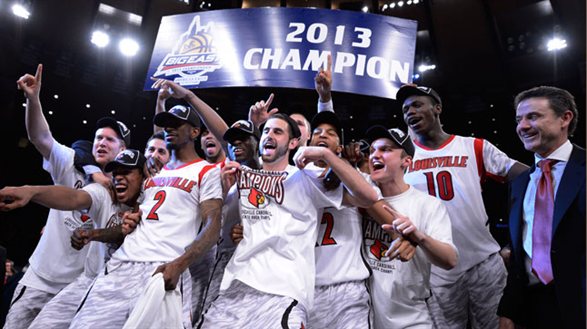
If any doubt still existed as to whether the University of Louisville was the right choice for membership into the Atlantic Coast Conference, those doubts were dashed on Saturday, March 16, 2013.

As I watched my beloved Cardinals struggle, persevere and then triumph against the Syracuse Orange in the last Big East Championship title game of the modern era, I couldn’t help but think about all the naysayers and detractors of Belknap’s athletic department as the ACC made its decision in 2012.

Louisville basketball has come a long way, to be sure. We were always the known unknown who entered and left conferences. From the Metro Conference to Conference USA to the Big East Conference, the pride of Louisville proved and proved and proved themselves to fans, outsiders and future conference brass by winning national titles and battling our way into Final Fours. When Rick Pitino was hired as head coach after legend Denny Crum wrapped up his career, fans instantly knew the future was bright and we would give our new coach as much time as he needed.

What we have accomplished as members of the Big East is still unfathomable in my eyes. I’m sure the Villanovas and Syracuses and Georgetowns and Connecticuts chided the decision to add us and others to their ranks and assumed they would continue to dominate the league. No one could have written the memorable storyline the Cardinals have produced since 2005.

Louisville became the winningest program since the realignment of 2005 and has now won its third conference basketball championship. As finalists of the tournament in four of the last five years, the Cardinals have continued to prove their worth on the hardwood.

2013 Big East Champions(Credits: www.bigeast.org)

2013 Big East Champions
(Credits: http://www.bigeast.org)

In football, Louisville has always faced an uphill challenge. Scheduling juggernauts like Alabama, Georgia and Notre Dame had been a difficult feat to claim, and recruiting the best players from around the country has never been our trademark. However, the football Cardinals made it their mission to always be satisfied with the progression of the program and to constantly improve from within.

Having won our two Bowl Championship Series matchups (2006 FedEx Orange Bowl and 2013 Allstate Sugar Bowl), we put everything on the field when we are placed on the stage and told to perform.

When Coach Charlie Strong chose to extend his contract at Louisville rather than take the Tennessee job with the Southeastern Conference, fans surrounding the university knew what he thought about his current job and the institution. The sigh of relief throughout the River City came from fans who realized that our time had finally come to keep our coach and strive to maintain and surpass our accomplishments.

Although elevated, it is clear head coach Charlie Strong is not satisfied with the heights of the program under his tutelage. The invitation to the ACC combined with the fashion in which Louisville dealt the Gators the loss in the Sugar Bowl sent the city into overdrive.

Coach Charlie Strong celebrates after the 2013 Sugar Bowl victory(Credits: Getty Images)

Coach Charlie Strong celebrates after the 2013 Sugar Bowl victory
(Credits: Getty Images)

All we ask is for a chance to prove our worth. That is all we have ever wanted, and it appears we will soon get our chance once again in the prestigious ACC in 2014.

Post Navigation